Contact for Pricing

NeuroClues

Eye-tracking medical device that uses AI to detect early biomarkers of Parkinson's, Alzheimer's, and multiple sclerosis.

4.3 Healthcare AI
4.3 Very good 4.3

Bottom line: NeuroClues is a strong healthcare ai tool, best known for portable, CE-marked Class IIa medical device for clinical eye-movement recording.

CE-marked Class IIa medical device status gives it real regulatory clearance, not only research-stage promise No published pricing, and as a clinical device it is sold directly to institutions, not individuals
Reviewed by Challenging Voice Editorial · Updated Aug 2026 How we rate
PricingContact for Pricing
Free planNo
CompanyneuroClues
PlatformsWeb
Best forHealthcare AI
Founded2020
Visits1
Last reviewedAug 2026
UpdatedAug 2026
Ask AI about NeuroClues ChatGPT Claude Perplexity

Overview

neuroClues builds a portable eye-tracking medical device that analyzes eye-movement biomarkers to support early diagnosis of neurological disorders. The company was founded in July 2020 as P3Lab by Antoine Pouppez, Pierre Daye, and Pierre Pouget, the latter two neuroscience researchers with more than 35 combined years studying oculomotor function, and is based in Louvain-la-Neuve, Belgium.

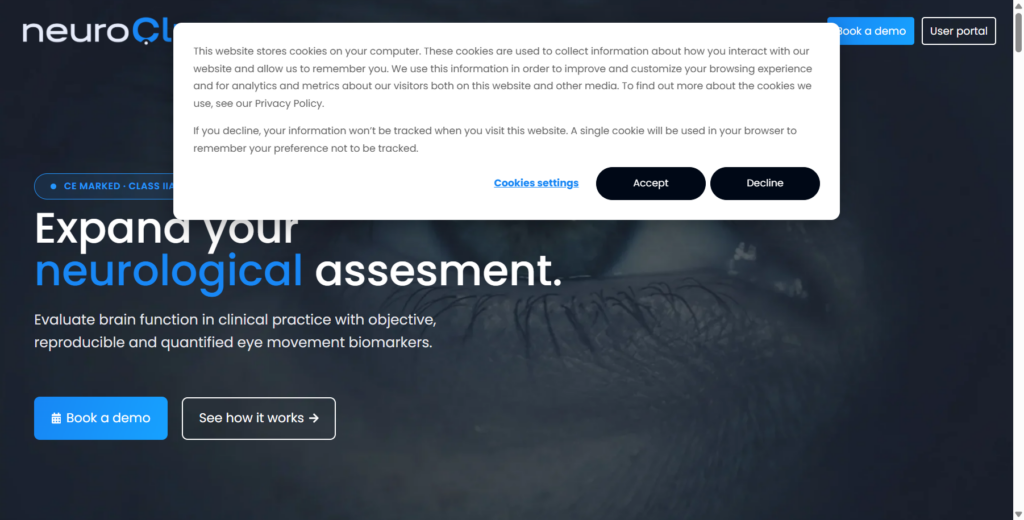
The CE-marked Class IIa device uses two infrared cameras recording at 400 frames per second while a patient performs short visual tasks, requiring no calibration setup specific to that patient. Proprietary AI algorithms then translate those eye movements into objective biomarkers displayed against reference ranges, aiming to flag signs of Parkinson's disease, Alzheimer's disease, and multiple sclerosis years before tremors or memory loss become clinically obvious. The company received CE certification in January 2025 and, within months, had more than 30 devices deployed across France, Belgium, Italy, Germany, Switzerland, the Netherlands, and the UK.

neuroClues is built for neurologists, university hospitals, and private neurology practices rather than individual consumers or general practitioners screening outside a neurology workflow. The company does not publish pricing for the device or its analysis software; deployment is arranged directly with hospitals and practices, and neuroClues has raised more than €22 million in funding and grants since 2020, including a €10 million Series A in April 2026.

Key features

  • Portable, CE-marked Class IIa medical device for clinical eye-movement recording
  • Calibration-free patient setup using dual infrared cameras at 400 fps
  • AI-derived biomarkers benchmarked against reference ranges for clinical interpretation
  • Early-detection targeting for Parkinson's, Alzheimer's, and multiple sclerosis
  • Deployment across university hospitals and private neurology practices in seven-plus countries
  • Research pedigree from founders with 35-plus combined years in oculomotor research

Screenshots & demo

Demo video

Screenshots

NeuroClues screenshot 1

Pricing

NeuroClues uses custom pricing. Contact their team for a quote based on your needs.

  • Pricing modelContact for Pricing
  • Starting priceCustom
  • Free planNo
Visit NeuroClues

Pricing is provided as a guide. Check the official site for the latest plans.

Pros & cons

Pros

  • CE-marked Class IIa medical device status gives it real regulatory clearance, not only research-stage promise
  • More than €22 million raised, including a €10 million Series A, signals investor confidence
  • Aims at detection years before visible symptoms, where neurological treatment has the most impact
  • Adopted across seven-plus European countries within months of certification

Cons

  • No published pricing, and as a clinical device it is sold directly to institutions, not individuals
  • Limited so far to the European market and CE marking, without confirmed FDA clearance
  • As a diagnostic aid, findings still require a neurologist's clinical interpretation, not a standalone verdict
  • Narrow focus on eye-movement biomarkers, so it complements rather than replaces broader neurological workup

How it compares

ToolRatingFreeFromBest known for
NeuroClues (this tool)4.3NoPortable, CE-marked Class IIa medical device for clinical eye-movement recording
Hippocratic AI4.3NoPatient-facing AI agents for pre-visit intake, follow-up, and check-ins
Tandem Health4.0Yes$133/moAI medical scribe that handles clinical documentation during patient visits
Paige4.1NoPaige Alba AI co-pilot for digital pathology tissue-slide analysis

Our verdict

4.3 / 5 4.3

NeuroClues is a strong healthcare ai tool, best known for portable, CE-marked Class IIa medical device for clinical eye-movement recording.

What makes it different: NeuroClues stands out for portable, CE-marked Class IIa medical device for clinical eye-movement recording.

How we score it
Overall 4.3
Value for money 4.2
Feature depth 4.9
Popularity 3.7
Best for ProfessionalsTeamsCreatorsCurious learners

Frequently asked questions

What is NeuroClues?
NeuroClues is a healthcare ai tool listed in the Challenging Voice directory. Eye-tracking medical device that uses AI to detect early biomarkers of Parkinson's, Alzheimer's, and multiple sclerosis.
Is NeuroClues free?
NeuroClues does not offer a free plan.
What are the best NeuroClues alternatives?
Popular alternatives to NeuroClues include Clare & Me, ThriveLink, and Artera. Browse them all in the Healthcare AI category.
Is NeuroClues any good?
NeuroClues scores 4.3 out of 5 based on our editorial review.

Reviews

4.3 No reviews yet

Write a review

Similar tools you might like