
List your tool
Contact for Pricing

Phonic

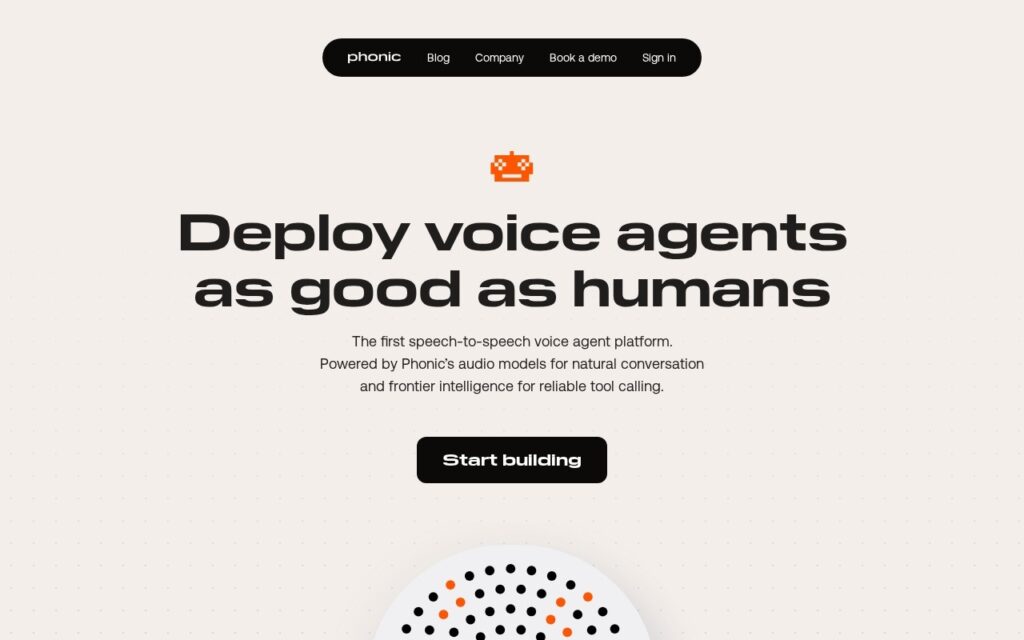
Speech-to-speech voice agents at 300ms latency – backed by Lux Capital and founders from Hugging Face, Replit and Modal – built for high-stakes customer calls.

4.0 Customer Support
4.0 Very good 4.0
Speech-to-speech architecture avoids the tone/prosody loss of cascaded systems No self-serve pricing – requires a sales conversation
Reviewed by Challenging Voice Editorial · Updated Aug 2026 How we rate
PricingContact for Pricing
Free planNo
CompanyPhonic AI
PlatformsAPI, Web
CategoryCustomer Support
Last reviewedAug 2026

Is this your tool?

  • Claim this listing. Sign in with an email at phonic.ai to manage it. Claim Phonic
  • Get into the top 5 of Customer Support. 5 of 5 spots open, from $159/month. See positions
  • Something out of date? Owners can request edits from My listings; anyone can tell us.
Ask AI about Phonic ChatGPT Claude Perplexity

Overview

Phonic runs voice agents on proprietary speech-to-speech audio foundation models, rather than the older “cascaded” approach (speech-to-text, then text processing, then text-to-speech) that most voice AI still uses, achieving speech-in-to-speech-out response within 300 milliseconds. It’s built for enterprise deployment – fully containerized, with searchable interaction records, real-time observability, and call-failure analysis – specifically for complex, high-stakes customer interactions.

True speech-to-speech architecture, not text as an intermediate step, is the specific technical claim that matters most here: cascaded voice agents lose prosody, tone and timing information converting to text and back, which is exactly what makes a lot of voice AI feel robotic and misread emotional cues, and Phonic’s architecture is built to avoid that loss entirely. Backing from Lux Capital and founders with backgrounds at Hugging Face, Replit and Modal is also a real signal of technical pedigree in this specific space.

This is infrastructure aimed at engineering teams building serious voice products, not a plug-and-play consumer tool, and “high-stakes customer interactions” specifically implies use cases where getting it wrong has real cost – thorough testing before production deployment matters more here than for a low-stakes voice bot. Pricing isn’t disclosed; expect a sales conversation.

Key features

  • True speech-to-speech architecture, not cascaded text-intermediate
  • 300ms speech-in-to-speech-out latency
  • Enterprise-grade containerized deployment
  • Real-time observability and call-failure analysis
  • Searchable interaction records

Screenshots & demo

Phonic screenshot 1

Pricing

Phonic uses custom pricing. Contact their team for a quote based on your needs.

  • Pricing modelContact for Pricing
  • Starting priceCustom
  • Free planNo
Visit Phonic

Pricing is provided as a guide. Check the official site for the latest plans.

Pros & cons

Pros

  • Speech-to-speech architecture avoids the tone/prosody loss of cascaded systems
  • Strong technical pedigree (Lux Capital, Hugging Face/Replit/Modal founders)
  • Built specifically for complex, high-stakes interactions, not generic FAQ bots

Cons

  • No self-serve pricing – requires a sales conversation
  • Engineering-team infrastructure, not a plug-and-play consumer tool
  • High-stakes use cases demand thorough testing before production deployment

How it compares

ToolRatingFreeFromBest known for
Phonic (this tool)4.0No—True speech-to-speech architecture, not cascaded text-intermediate
Vogent4.0No—No-code Flow Builder for agent design
Retell AI4.2YesFreeRoughly 600ms latency tuned specifically for phone conversations
CodeBaby3.8No—Real-time conversational AI avatars with LLM-powered dialogue

Alternatives to Phonic

4 tools matched to Phonic on what they do, their category and their price.

CodeBaby

3.8

Real-time conversational AI avatars for customer service, healthcare intake and hospitality concierge – deployable as DIY, managed, or even hologram integration.

Contact for Pricing Customer Support

Moveo.AI

3.4

AI agents work across voice, chat, email, and WhatsApp with memory that persists across every interaction – reported 75% lower call center costs and 90% automation rates for banks and insurers.

Contact for Pricing Customer Support

Frequently asked questions

What is Phonic?
Phonic runs voice agents on proprietary speech-to-speech audio foundation models, rather than the older "cascaded" approach (speech-to-text, then text processing, then text-to-speech) that most voice AI still uses, achieving speech-in-to-speech-out response within 300 milliseconds.
Is Phonic free?
Phonic does not offer a free plan.
What are the best Phonic alternatives?
The closest matches in the directory are Vogent, Retell AI, and CodeBaby, compared side by side above.

Reviews

4.0 Editorial rating No reviews yet

Write a review

More tools like Phonic