
List your tool
Contact for Pricing

Qloo

Cultural taste graph of 3.7 billion entities that predicts preference across categories.

4.2 Data and Analytics
4.2 Very good 4.2
Answers the cross-category question behavioural data cannot No published pricing
Reviewed by Challenging Voice Editorial · Updated Aug 2026 How we rate
PricingContact for Pricing
Free planNo
CompanyQloo, Inc.
PlatformsAPI, Web
CategoryData and Analytics
Last reviewedAug 2026

Is this your tool?

  • Claim this listing. Sign in with an email at qloo.com to manage it. Claim Qloo
  • Get into the top 5 of Data and Analytics. 5 of 5 spots open, from $159/month. See positions
  • Something out of date? Owners can request edits from My listings; anyone can tell us.
Ask AI about Qloo ChatGPT Claude Perplexity

Overview

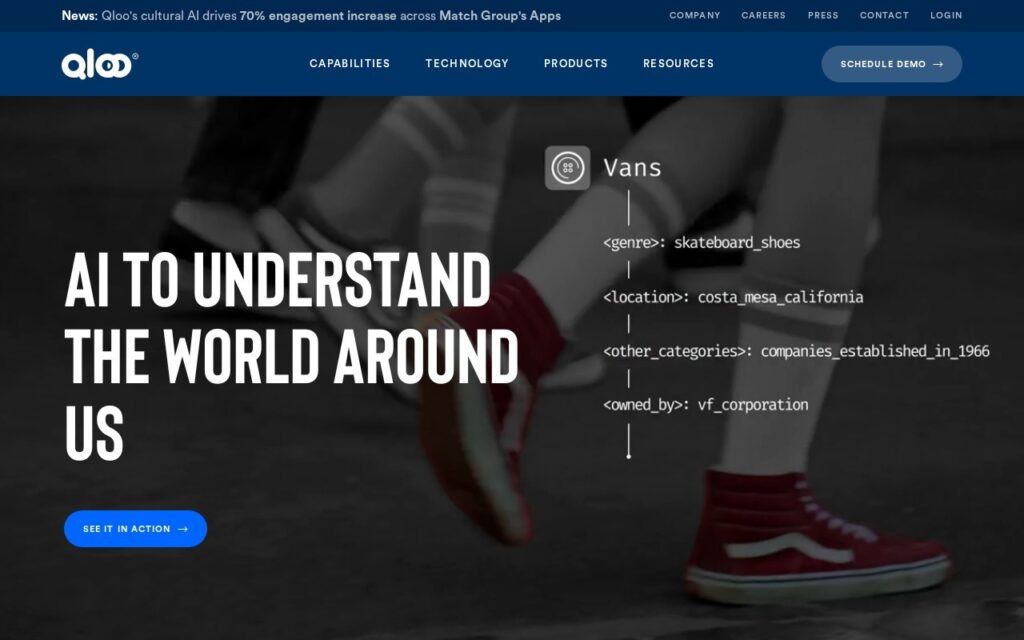
Qloo maps taste. Its knowledge graph holds around 3.7 billion cultural entities, restaurants, hotels, music, films, brands and destinations, connected by more than ten trillion preference signals, and the useful trick is crossing between categories: inferring what somebody will want to eat from what they listen to.

That cross-domain inference is what conventional recommendation cannot do. A system trained on your purchases in one category knows nothing about you in another, which is why every recommender starts cold with each new customer, and a graph of how tastes correlate across culture answers a question that behavioural data alone cannot.

It licenses the graph, offers audience intelligence and taste analysis, and integrates with LLMs and agents including on-device deployment. Netflix, PepsiCo, Match Group and Michelin are named as customers, with a 273 percent booking increase cited for Michelin’s Tablet Hotels. Nothing is priced publicly, the graph reflects the cultures its data came from, and taste inference across categories is probabilistic in a way that individual predictions will not always survive.

Key features

  • Knowledge graph of about 3.7 billion cultural entities
  • Cross-domain preference prediction
  • Audience intelligence and taste analysis
  • Data licensing of the cultural graph
  • LLM, agent and on-device integration

Screenshots & demo

Demo video

Screenshots

Qloo screenshot 1

Pricing

Qloo uses custom pricing. Contact their team for a quote based on your needs.

  • Pricing modelContact for Pricing
  • Starting priceCustom
  • Free planNo
Visit Qloo

Pricing is provided as a guide. Check the official site for the latest plans.

Pros & cons

Pros

  • Answers the cross-category question behavioural data cannot
  • A decade of graph building behind it
  • Works on-device as well as through an API

Cons

  • No published pricing
  • The graph reflects the cultures its data came from
  • Cross-category inference is probabilistic at the individual level

How it compares

ToolRatingFreeFromBest known for
Qloo (this tool)4.2No—Knowledge graph of about 3.7 billion cultural entities
Tamr4.3No—Entity resolution using AI and external data

Alternatives to Qloo

1 tool matched to Qloo on what it does, its category and its price.

Tamr

4.3

AI-native master data management platform that matches, cleans and enriches records into golden records using entity resolution, AI agents with human oversight, a knowledge graph and an MCP connection for LLMs.

Contact for Pricing Data and Analytics

Frequently asked questions

What is Qloo?
Qloo maps taste. Its knowledge graph holds around 3.7 billion cultural entities, restaurants, hotels, music, films, brands and destinations, connected by more than ten trillion preference signals, and the useful trick is crossing between categories: inferring what somebody will want to eat from what they listen to.
Is Qloo free?
Qloo does not offer a free plan.
What are the best Qloo alternatives?
The closest matches in the directory are Tamr, compared side by side above.

Reviews

4.2 Editorial rating No reviews yet

Write a review