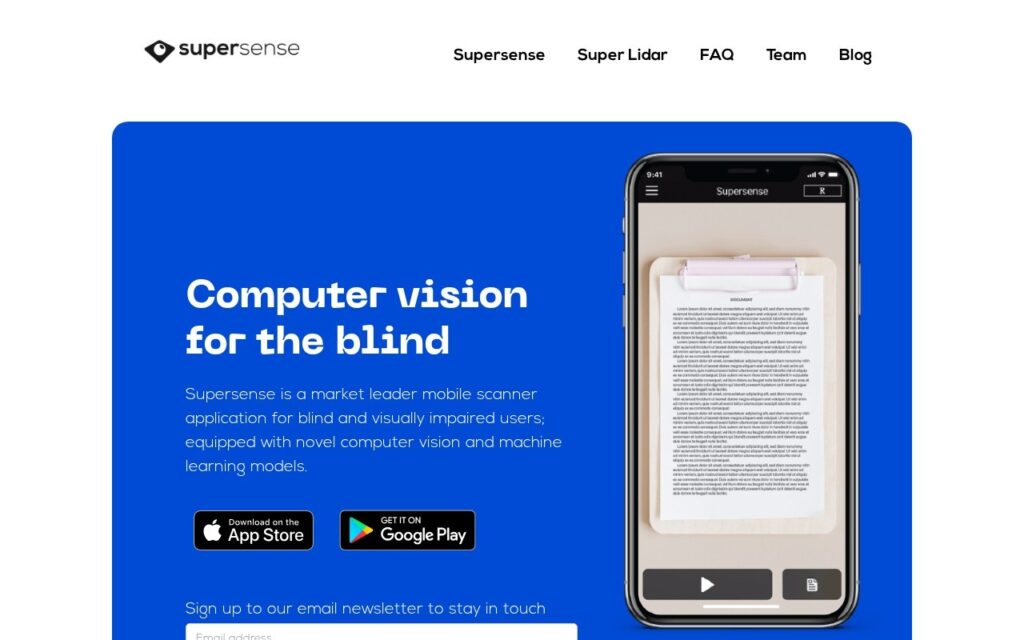
Supersense uses its own computer vision and machine learning models to automatically detect what a user is pointing their phone camera at and begins reading it aloud right away, covering letters, documents, books, currency, barcodes and more without the user needing to select a mode first. A companion app, Super Lidar, uses a phone’s LiDAR sensor to help a blind or visually impaired user locate people and objects around them and understand the layout of a space. Both apps are built by Mediate, an MIT-spinoff research lab founded in 2017 and based in Cambridge, Massachusetts, operating under the legal name Virtual Collaboration Research Inc, and are among the most downloaded and highest-rated apps for the blind on both the App Store and Google Play.
Supersense reports what its camera and computer-vision models detect, so like any assistive scanning tool it works best as a complement to a user’s existing mobility aids and orientation training rather than a full replacement for them. Recognition accuracy for any computer-vision tool can vary with lighting, distance and how an object is held relative to the camera.
Both Supersense and Super Lidar are free to download and use, with no premium tier or in-app purchase presented on the company’s own site.