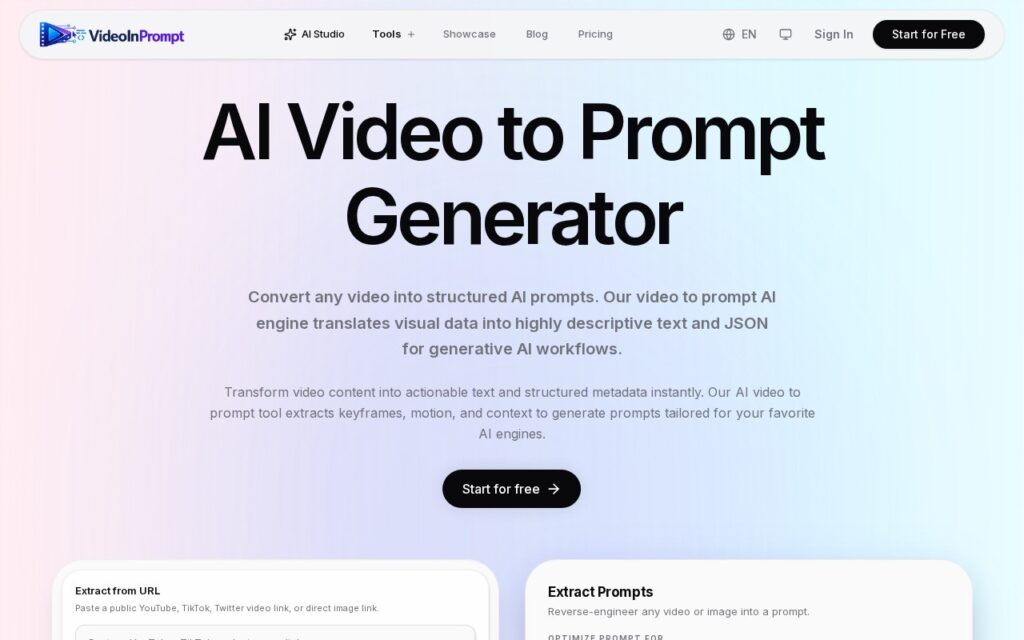
VideoInPrompt reverse-engineers footage into prompts. Paste a public YouTube, TikTok or X link, or a direct image, and it extracts keyframes, motion and context and returns a highly descriptive prompt as text and structured JSON, tuned for the generative engine you name. An AI Studio, a showcase and prompt-optimisation tools sit alongside.
Structured JSON rather than a paragraph is what makes this a workflow tool instead of a curiosity. Prompts have become configuration – camera movement, subject, lighting, style and duration as separate fields that a pipeline can vary one at a time – and a descriptive sentence cannot be programmatically adjusted. Emitting the structure means the output feeds a batch process rather than a text box.
Learning to prompt by taking apart video that already works is a genuinely good teaching method, and the same capability is a style-copying machine pointed at other people’s published work. That is worth being clear about rather than presenting it purely as analysis. There is a free start and pricing on a separate page, no company is named, and a reconstructed prompt describes what a model would need to approximate a clip – not how the original was actually made.