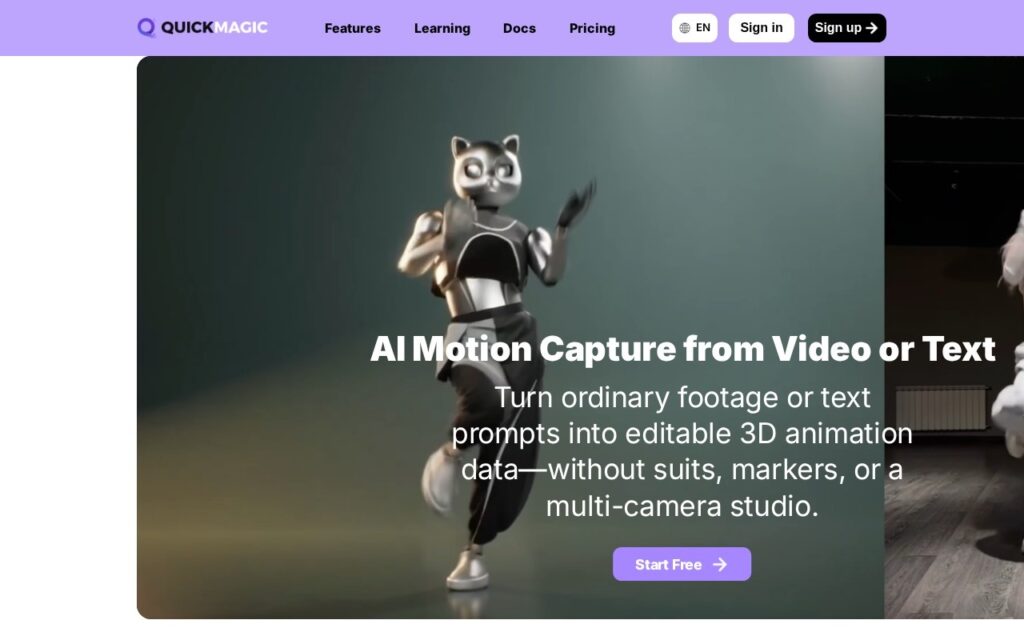
QuickMagic estimates full-body, hand and facial movement from a single video and turns it into editable 3D animation data, with no suit, markers or studio. It also generates motion from a text prompt, handles multiple subjects and moving-camera footage, and exports to FBX, BVH, BIP, C4D and VMD for Blender, Unreal, Unity and Maya. Humanoid robot motion reference is a supported workflow.
Coping with a moving camera is the capability that decides whether this is usable on real footage. Markerless capture is easy to demonstrate on a locked-off shot of someone walking in a straight line, and useless the moment the source is a handheld clip – which is what almost all reference footage actually is. Handling that, plus several subjects at once, is the difference between a demo and a pipeline tool.
Plans run Free, Basic at $14.90 a month, Pro at $49.90, Max at $179.90 and Studio at $499.90, each 20 percent cheaper billed yearly and each covering both the Mocap and Avatar product lines with different credit allowances. Single-camera capture produces depth ambiguity that a cleanup pass has to resolve, hand and finger tracking degrades fastest when the source is low resolution, and the jump from Pro to Max is more than triple the price.