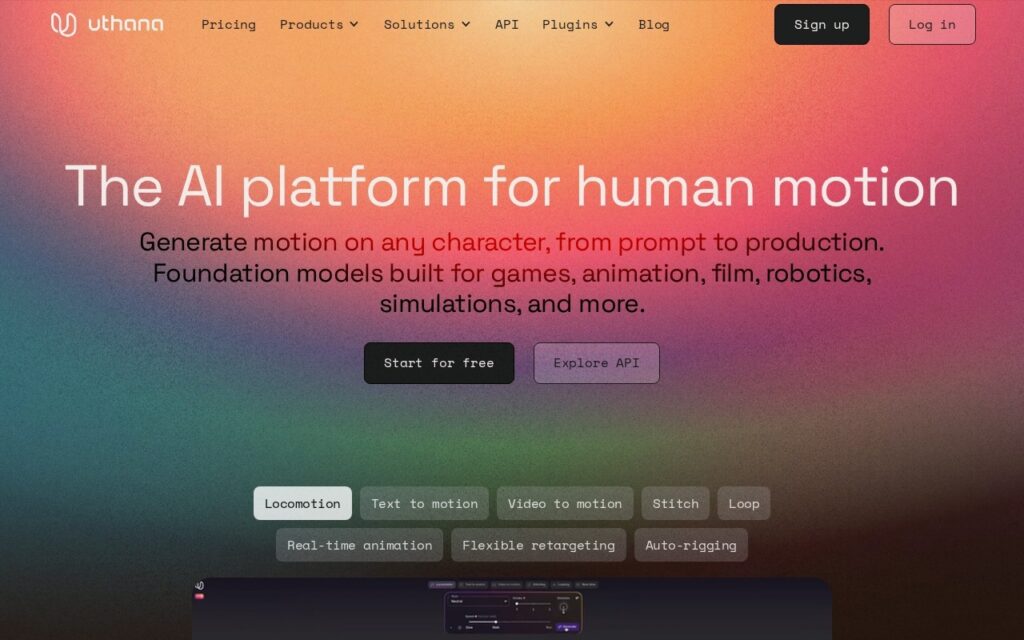
Uthana generates human motion rather than images or video. Text prompts, 2D video and pose constraints all go in; 3D motion files come out, in FBX, GLB and BVH, ready for Maya, Blender, Unreal, Unity and Roblox. The generation side covers locomotion, text-to-motion and video-to-motion, and the production side covers what actually makes motion usable – stitching clips together, looping them cleanly, auto-rigging and retargeting onto a different skeleton.
That production half is what separates this from a demo. Anyone who has tried to use generated animation knows the generation was never the bottleneck: retargeting onto your own character rig and getting a loop that does not visibly pop is where the days go. Shipping retargeting and looping as first-class features, alongside a library of more than 100,000 studio-quality motion assets, addresses the real workflow rather than the impressive part of it.
The caution is that generated motion is judged by a harsher standard than generated images, because humans read gait and weight transfer unconsciously and notice wrongness they cannot articulate – background characters and previsualisation are a far safer use than a hero animation. Pricing is metered per second of output – text to motion from $0.02 a second, video to motion $0.05, auto-rigging $0.15 a rig, character generation $0.75 – which is transparent but hard to budget until you know your volume. The company is Uthana, Inc.