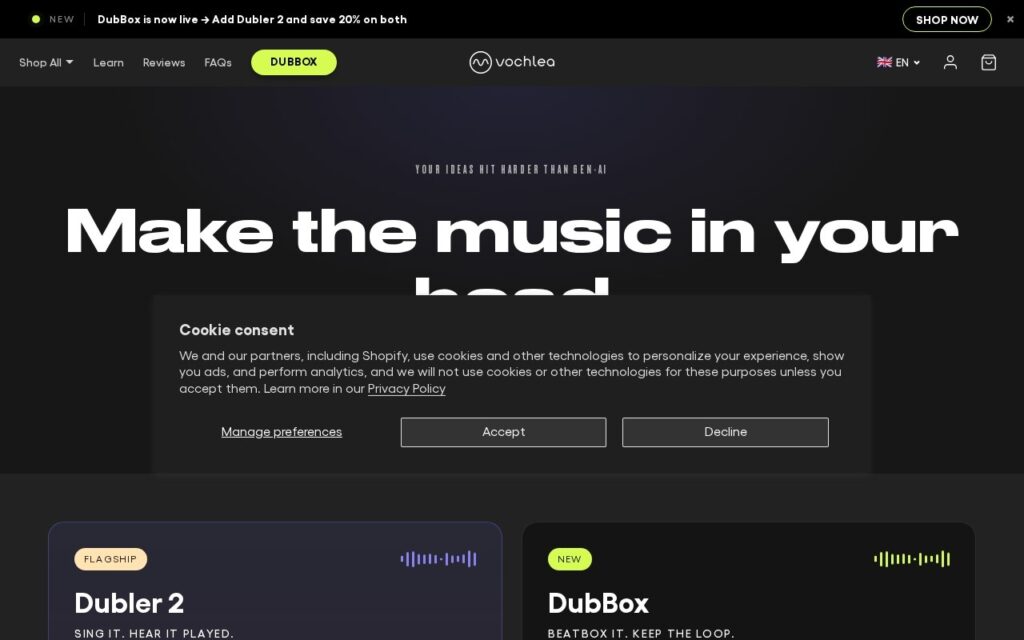
Dubler 2 uses an AI audio engine to track the pitch, timbre and rhythm of a user’s voice in real time and translate it directly into MIDI, letting a musician sing a melody to get a chord progression, hum a bassline without touching a keyboard, or beatbox a drum pattern that triggers real drum samples. The system can be trained and calibrated to an individual’s specific voice and percussive sounds, detects velocity for dynamic recording, maps vowel sounds to control effects and filters, and includes auto key detection that locks singing to the detected key. A companion product, DubBox, turns rough beatboxing into a finished, DAW-ready drum loop with smart quantization and editable kits. Vochlea Music Ltd was founded in 2017 in London by George Wright and Daven Sanassy, and the company states its products have earned more than 2,000 customer reviews.
Vochlea’s own current marketing deliberately avoids the word “AI” and even positions Dubler against generic “Gen-AI” hype, but independent press coverage and third-party technical reviews describe the underlying pitch, timbre and percussive recognition engine as genuinely AI-powered and trained per user — worth knowing the branding and the substance differ here. As with any voice-controlled instrument, results depend on a user’s own vocal control and the quality of the training/calibration process, and it works alongside a DAW rather than replacing one.
Dubler 2 (software only) is a one-time purchase, with third-party retailers listing it at $249; the Dubler Studio Kit 2 bundle, which adds a calibrated USB microphone, lists at $329. DubBox, the companion beatbox-to-drum-loop product, is sold separately as a one-time purchase and discounted when bought alongside Dubler 2. A 14-day money-back guarantee applies to Dubler 2.