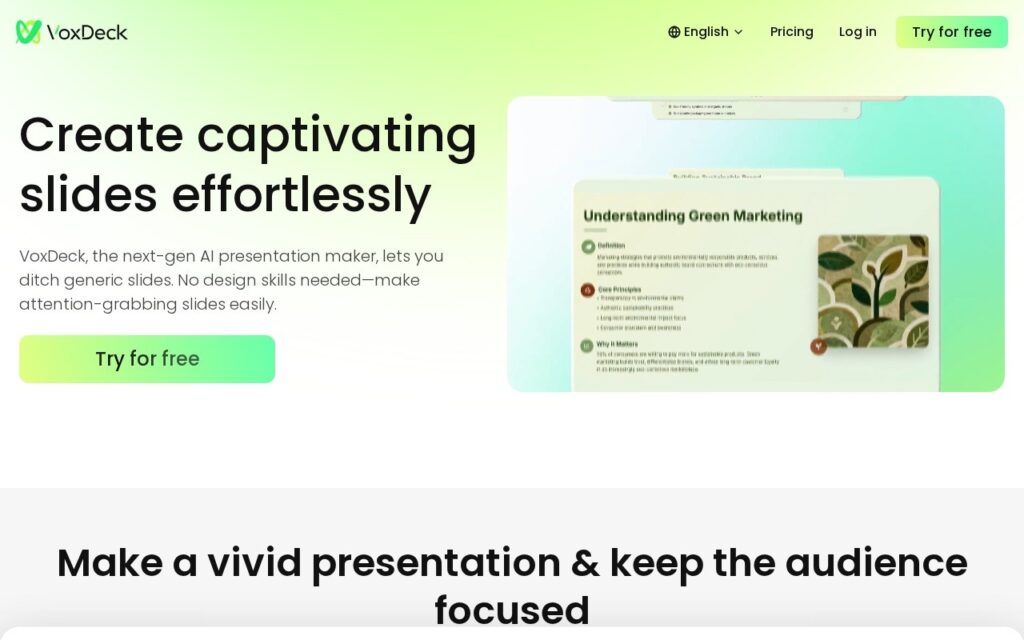
VoxDeck builds presentations from raw material. Notes go in and structured slides come out, with animations chosen to match what each slide is saying rather than applied uniformly, themes switchable in one click, brand controls holding logo and visual identity consistent across a deck, and a presenter avatar that can narrate the slides. It targets education, marketing, finance and research.
Context-matched animation is a more considered feature than it sounds. The reason generated decks look generated is that motion gets applied as decoration – every bullet flying in the same way regardless of whether it is a sequence, a comparison or a conclusion – and matching the transition to the relationship between ideas is the difference between animation that carries meaning and animation that distracts. Brand consistency tooling is the other unglamorous thing decks need and generators usually skip.
The narrating avatar deserves more scepticism than the rest. A deck narrated by a synthetic presenter is fine for asynchronous training or a product walkthrough, and actively counterproductive anywhere the audience expected a person – the reason to watch a presentation is usually the presenter. The time-saving claims (three hours to twenty minutes) are user-reported with no methodology, and no rates appear beyond a free trial, which for a tool aimed at finance and education teams is the first question a buyer will ask.