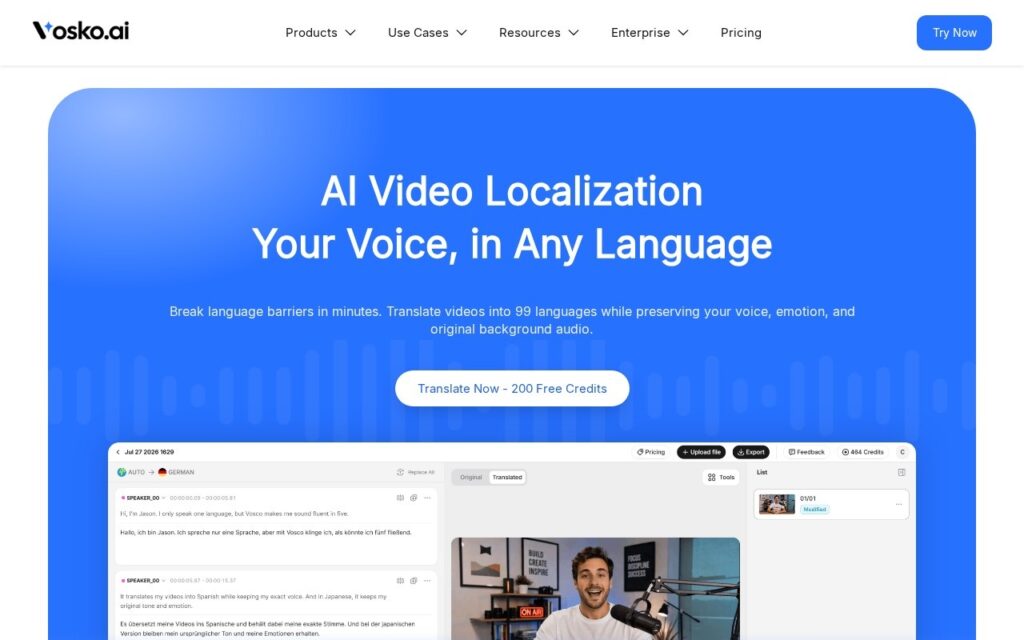
Vosko localises video by translating and dubbing it while keeping the original speaker’s timbre, tone and emotional delivery. It separates overlapping speakers automatically, leaves background music and sound effects untouched, detects and erases hardcoded on-screen subtitles with background reconstruction, and gives a side-by-side script editor with automatic timing resync and manual control over pitch, pacing and emotion.
Subtitle removal is the unglamorous feature that decides whether this is usable on real archives. A large share of existing video already has captions burned into the picture, and dubbing it into another language leaves the old text sitting on screen contradicting the audio – which is why most localisation projects quietly stop at whatever footage still has a clean master. Reconstructing the background behind the text is what opens up the back catalogue.
The company claims 99-plus target languages, 99.2 percent voice timbre fidelity, 99.8 percent precision separating overlapping speakers, 85 percent lower localisation cost and 100,000-plus users. There are 200 free credits to start and no published plan rates. Every one of those figures is the vendor’s own with no stated method, a preserved voice speaking a language its owner does not is a consent question worth settling before publishing, and emotional delivery is the part of dubbing that human directors still argue about.