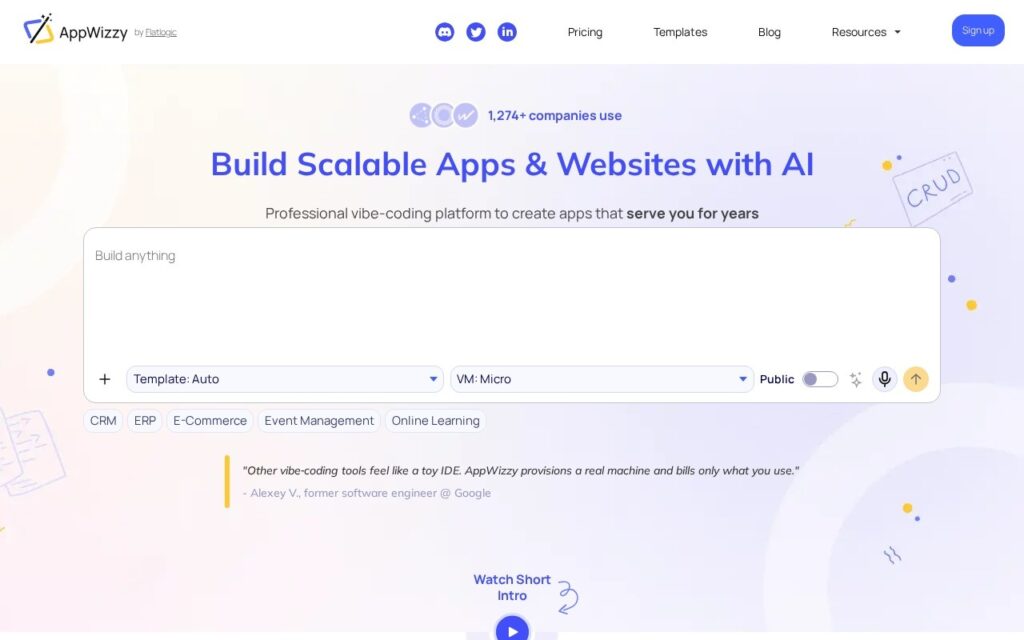
AppWizzy builds full-stack web applications from a conversation, and the distinction it draws is where the code runs. Rather than generating front-end code in a sandbox, it provisions an actual development machine – PHP, Python, Node and Next, Postgres and MySQL – so applications have real backend logic, real databases and real integrations. Git integration and VS Code access sit alongside the AI editor, with one-click deployment through a CI/CD pipeline and a template marketplace covering landing pages, SaaS, CRM, e-commerce, admin and portal starters. It is built by Flatlogic.
The real-VM architecture is a meaningful difference rather than a marketing one. The standard failure of conversational app builders is that they produce a convincing front end and then stall the moment the application needs a database migration, a scheduled job or a third-party integration – having a machine with Postgres on it changes which projects can finish. Git and VS Code access matter for the same reason: when the AI reaches its limit, a developer can take over instead of starting again. The ‘Bad-AI’ refund on incorrect edits within ten minutes is an unusually concrete admission that it will sometimes be wrong.
Read the credit system carefully before budgeting. One credit equals one dollar, and credits pay for three different things – AI tokens, daily hosting from $0.10 a day, and template licences – so Pro at $20 a month for 25 credits is not 25 credits of app building once hosting is drawn from the same pot. Free gives 5 credits and up to three public apps; Pro 50 is $50 for 60 credits. The output is still generated code that someone needs to own.