
Freemium Verified

Capacities

Structured object types, not just freeform blocks

4.3 Productivity
4.3 Very good 4.3
Structured object types reduce disorganized freeform note sprawl More structure means more upfront setup than a purely freeform notes app
Reviewed by Challenging Voice Editorial · Updated Jul 2026 How we rate
PricingFrom $12/mo
Free planYes
CompanyCapacities Labs GmbH
PlatformsAndroid, iOS, Mac, Web, Windows
CategoryProductivity
Founded2022
Visits30
Last reviewedJun 2026
UpdatedJul 2026
Ask AI about Capacities ChatGPT Claude Perplexity

Overview

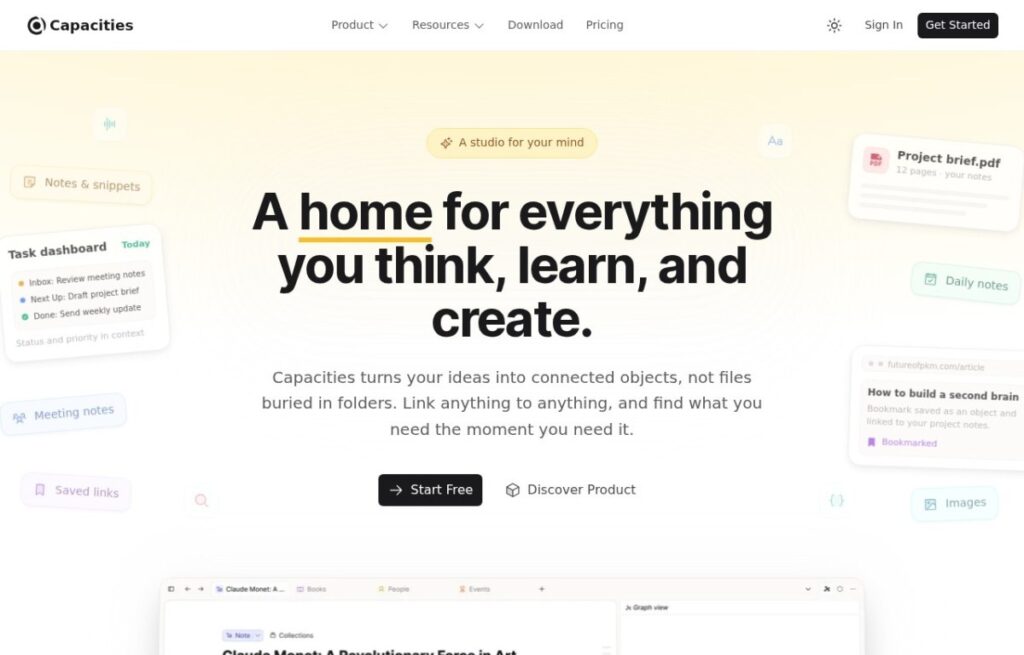
Capacities, built by Capacities Labs, takes a more structured approach to personal knowledge management than purely freeform, block-based notes apps: content gets organized into defined object types, a book, a person, a daily note, each with its own specific properties, rather than every note living as an identical generic block regardless of what it actually represents.

That structured-object approach matters for anyone whose knowledge base grows large and messy over time in a purely freeform tool: a "book" object can consistently track author and rating fields, while a "person" object tracks how you know them, structure that emerges automatically from the content type rather than being manually recreated in every new note.

A free tier covers standard use, and paid plans start around $12 a month for more storage and features. For someone who wants their notes to carry real, consistent structure based on what kind of thing each note actually represents, rather than a fully freeform block editor, Capacities' object-typed approach addresses that specific organizational need directly.

Key features

  • Structured object types (books, people, projects) with defined properties
  • Automatic structure based on content type
  • Free tier for standard use
  • Visual, interconnected knowledge graph
  • Operating with a distinct object-based data model
  • Consistent properties across similar note types

Screenshots & demo

Demo video

Screenshots

Capacities screenshot 1

Pricing

Free
Free
  • Core object based notes
  • Daily notes and tags
  • Limited AI usage
Pro
$12/mo
  • Expanded AI assistant
  • File uploads and storage
  • PDF annotation
  • Priority support

Is Capacities expensive?

Capacities starts at $12, which is right at the Productivity median of $11.3 a month across the 164 priced tools we list in that category.

The cheapest paid option in Productivity starts at $0.29 and the most expensive at $165.

71% of Productivity tools in the directory offer a free tier, and this is one of them.

Compared against every priced listing in Productivity, recalculated as the catalogue changes. Method and the full market breakdown are in our AI tool pricing study.

Pros & cons

Pros

  • Structured object types reduce disorganized freeform note sprawl
  • Consistent properties automatically apply across similar content types
  • Free tier available for everyday use
  • Visual knowledge graph helps surface connections between notes

Cons

  • More structure means more upfront setup than a purely freeform notes app
  • Smaller community and template ecosystem than larger competitors
  • More storage and advanced features require a paid plan

How it compares

ToolRatingFreeFromBest known for
Capacities (this tool)4.3Yes$12/moStructured object types (books, people, projects) with defined properties
Anytype4.2Yes$10/moLocal-first architecture with end-to-end encryption
Tana4.3Yes$5/moSupertags adding structured fields to freeform outline text
Supernormal4.3Yes$18/moMeeting-type-matched note templates

Alternatives to Capacities

4 tools matched to Capacities on what they do, their category and their price.

Frequently asked questions

What is Capacities?
Capacities is a productivity tool. Structured object types, not just freeform blocks.
Is Capacities free?
Yes, Capacities offers a free plan. Paid plans unlock more features and higher usage limits, starting at $12/month.
How much does Capacities cost?
Capacities plans: Free Free; Pro $12/mo.
What are the best Capacities alternatives?
The closest matches in the directory are Anytype, Tana, and Supernormal, compared side by side above.

Reviews

4.3 No reviews yet

Write a review

More tools like Capacities