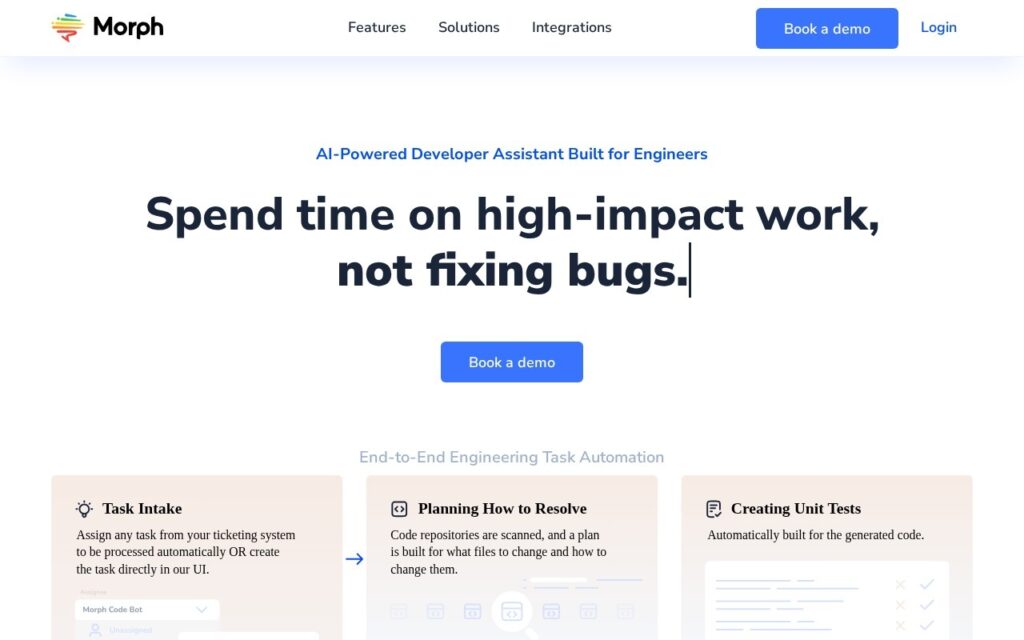
Morph is an AI developer assistant that works at the level of whole engineering tasks rather than autocomplete. You give it a feature request, a bug description or a stack trace, and it returns a code change that has been run against your own test suite.
The inputs are the ones engineers actually have: a description of a feature or change, a stack trace, or an account of what is not working. Morph also generates unit tests and documentation, the work that gets skipped under deadline pressure and is missed later.
What sets Morph apart is verification. Generated code is run against your existing test suite instead of only being produced, which is the difference between a suggestion and a change you can evaluate. It also means Morph inherits whatever quality bar your tests already enforce. It adapts to each language’s conventions and your styling requirements. The corollary is plain: on a codebase with weak test coverage, the verification loop has little to check against.
How does Morph AI handle an engineering task?
Morph takes a task in the form you already have it and returns a tested code change. The flow below is based on the tool’s described behaviour; details of the interface may differ.
- You describe a feature, change or bug, or paste a stack trace.
- Morph writes the code change, following the conventions of the language and your styling rules.
- The change is run against your existing tests, and unit tests and documentation are generated alongside it.
- You review the result before merging.
Task-level automation still needs human review, so treat the output as a proposed change, not a finished one.