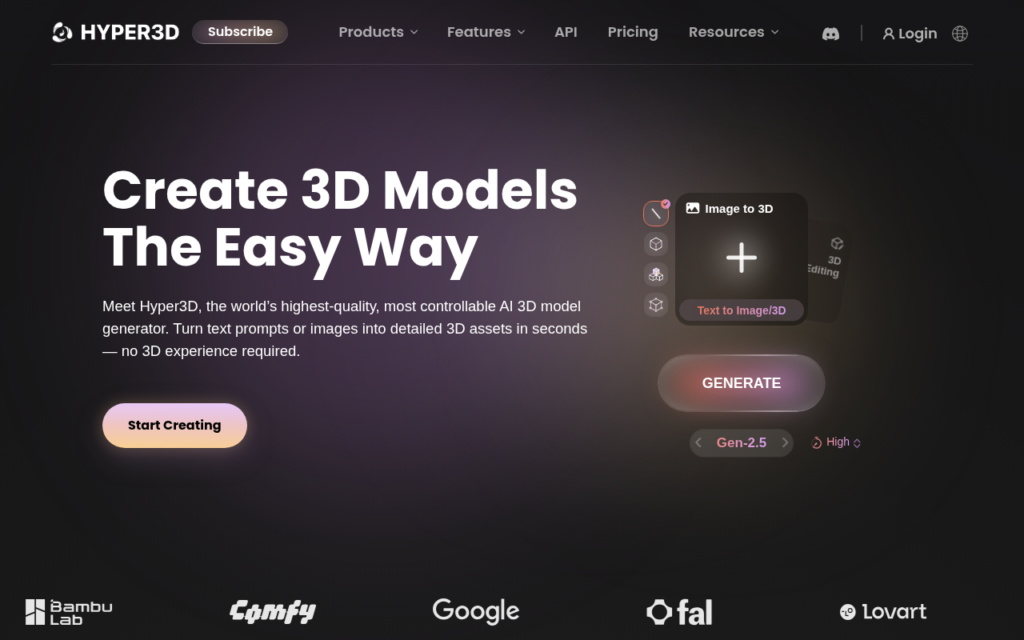
Hyper3D Rodin generates 3D models from text prompts or reference images, and positions the output as production-ready rather than as concept meshes. That claim is the one that matters: plenty of 3D generators produce something recognisable that is unusable in an actual pipeline because the geometry is unclean.
The audiences it names, 3D artists, game developers and 3D printing, have different requirements, and printing in particular is unforgiving since a mesh with holes or non-manifold geometry simply fails to print. Serving that use case implies real attention to mesh quality rather than visual approximation.
3D asset creation is among the slowest steps in game and product development, so compressing it to seconds changes what small teams can attempt. Generated models will still need cleanup for demanding work, and there is a free tier to assess mesh quality against your own pipeline.
Key features
3D model generation from text or reference images
Output aimed at production pipelines rather than concept meshes
Supports game development, 3D art and 3D printing
Detail controls rather than single-shot generation
Free tier for evaluating mesh quality
Screenshots & demo
Demo video
Screenshots
Pricing
Rodin offers a free plan, with paid upgrades for higher limits and more features.
Pricing is provided as a guide. Check the official site for the latest plans.
Is Rodin expensive?
Rodin has no advertised paid tier. Among the 105 priced tools we list in Design, the median entry price is $15 a month.
72% of Design tools in the directory offer a free tier, and this is one of them.
Compared against every priced listing in Design, recalculated as the catalogue changes. Method and the full market breakdown are in our AI tool pricing study.
Pros & cons
Pros
Targets usable geometry, not just recognisable shapes
Serving 3D printing implies genuine mesh quality
Compresses the slowest step in asset creation
Cons
Demanding work still needs manual mesh cleanup
Complex or highly specific models remain difficult