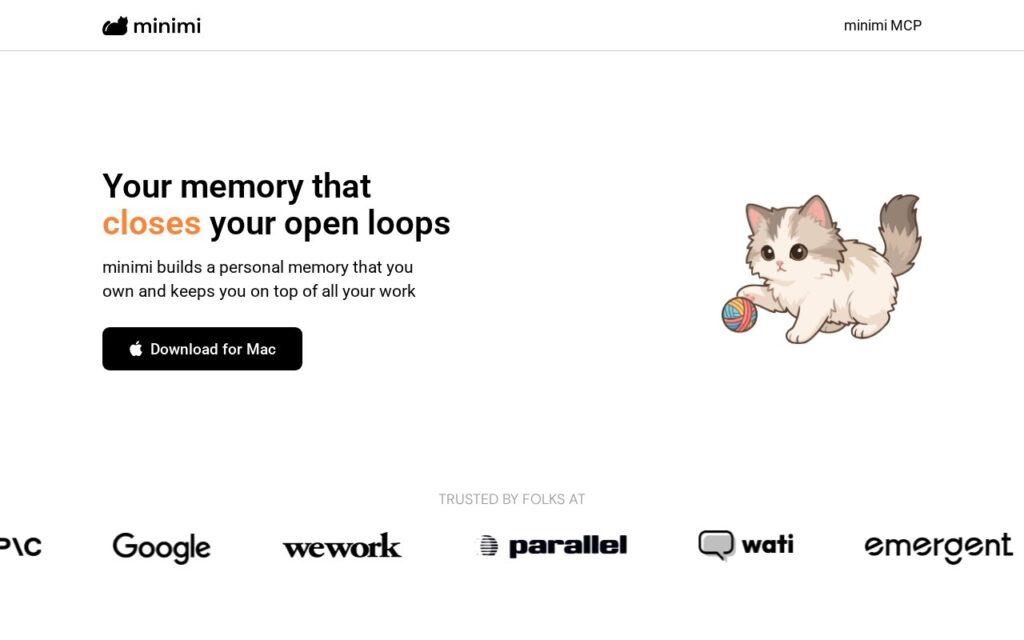
minimi assembles a memory of what you have been working on and uses it to surface the threads you left unfinished. Open loops are the real failure of personal productivity: the task you half-started and stopped thinking about is invisible to every list you keep, because you never wrote it down.
The memory is presented as yours rather than as something locked inside one assistant, and it connects outward so other tools can read it.
It is free. The long-term model is unclear, which matters for something holding a record of everything you do, that record is unusually sensitive by nature, and the product is early with little public detail about how it stores or protects any of it.
Key features
Personal memory built from your own work
Surfacing of unfinished threads
Memory you own rather than locked to one assistant
Connects outward to other tools
Free to use
Screenshots & demo
Pricing
minimi offers a free plan, with paid upgrades for higher limits and more features.
Pricing is provided as a guide. Check the official site for the latest plans.
Is minimi expensive?
minimi has no advertised paid tier. Among the 197 priced tools we list in Productivity, the median entry price is $10 a month.
70% of Productivity tools in the directory offer a free tier, and this is one of them.
Compared against every priced listing in Productivity, recalculated as the catalogue changes. Method and the full market breakdown are in our AI tool pricing study.
Pros & cons
Pros
Memory is portable rather than trapped in one assistant
Targets open loops, which lists never capture
Free
Cons
Long-term business model is unclear
A record of everything you do is unusually sensitive data
Early product with little public detail on storage or protection
Kuma, Baserow's AI Assistant, builds your data structure from a plain-language description – open source, with AI Agents and MCP Server support for ChatGPT, Mistral, and Claude.