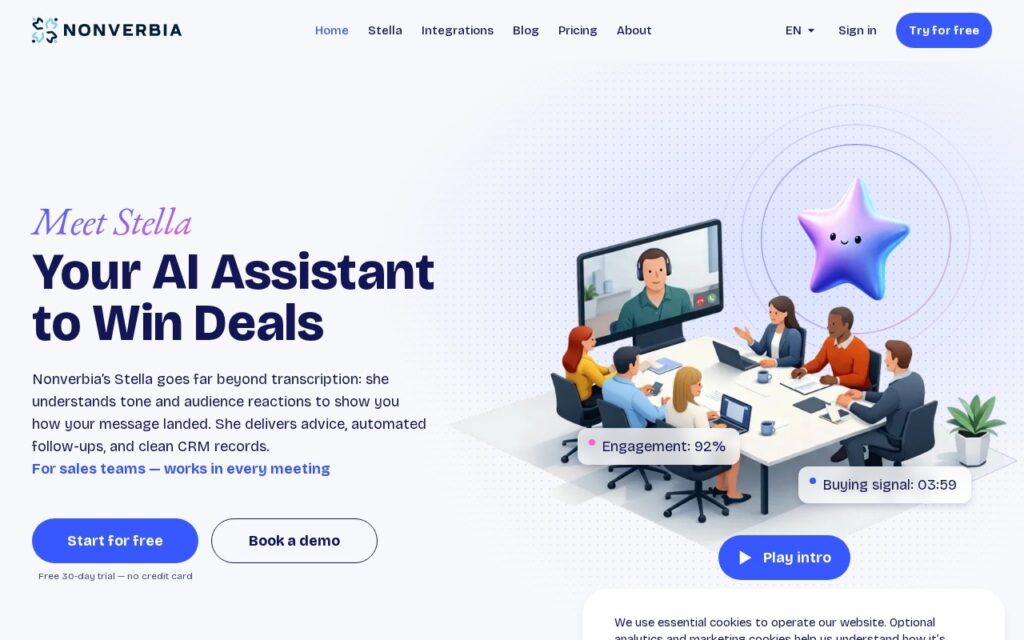
Nonverbia’s assistant, Stella, sits in sales meetings and reports on more than what was said. It transcribes, then infers tone and audience reaction to show how a message landed – the interface surfaces readouts like engagement percentages and timestamped buying signals – and follows up with coaching advice, automated follow-ups and cleaned CRM records. It works across meeting platforms, with a 30-day trial and no card required.
The transcription, follow-up and CRM half is straightforwardly useful and would justify a listing on its own. Sales calls generate admin that nobody does, records decay because writing them up competes with the next call, and a system that produces clean CRM entries without anyone typing is solving a problem every sales organisation actually has. Coaching from a recording is well-established practice too.
The reading-the-room half needs stating plainly, in two parts. First, inferring emotion from vocal tone and facial reaction is considerably more contested than a ‘92% engagement’ readout implies – the research consensus is that expression maps onto internal state far less reliably than the interface’s precision suggests, and a confident number attached to a weak inference is worse than no number, because people act on it. Second, and concretely: **the EU AI Act restricts emotion-inference systems in workplace settings**, with narrow exceptions. Whether your use falls inside that depends on who is in the meeting and where they are, and it is a question to resolve before deployment rather than after. Everyone on the call should also know it is running.