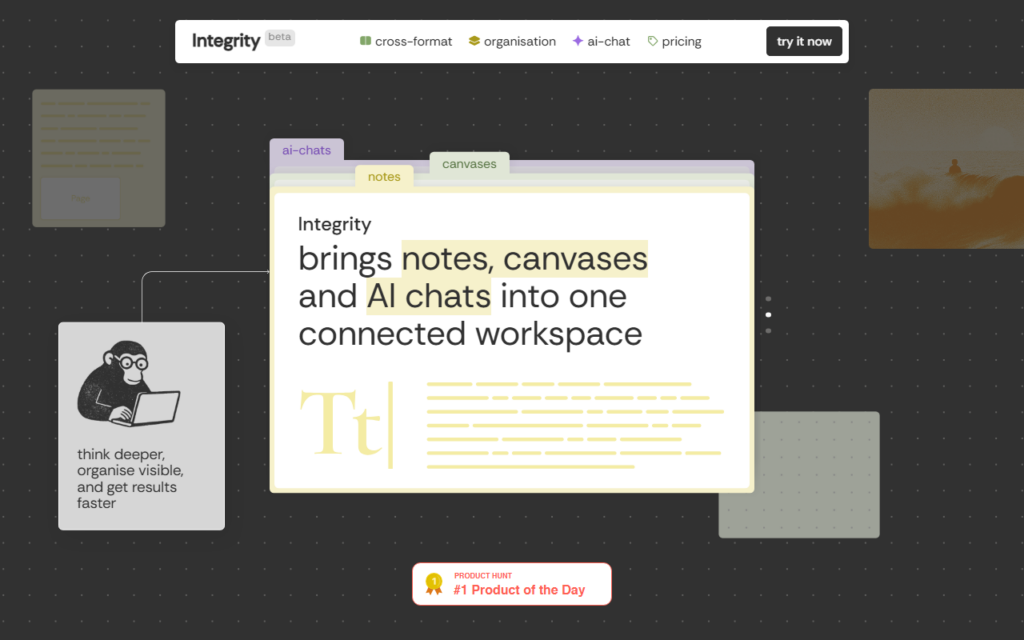
Integrity collapses three tools into one surface: structured notes, an infinite canvas for visual thinking, and AI chat that reads both. The target is the common stack of a document tool, a whiteboard and a separate assistant, where context has to be pasted between them at every step.
Because the assistant sits inside the workspace, it can reason over the notes and canvas the user already built rather than over a pasted excerpt. That is the practical gain — a chat that knows the project without being briefed each session.
Adoption cost is the usual objection to any consolidation play: teams already invested in an existing notes tool have to migrate to feel the benefit. A free tier and low entry pricing make trialling it on a single project reasonable before any migration decision.
Key features
Structured notes and infinite canvas in one workspace
AI chat with access to notes and canvas context
Project-level organisation across formats
Linked hierarchy connecting documents and visual work
Free tier plus low-cost paid plans
Cross-format search over a project
Screenshots & demo
Pricing
Integrity has a free plan, and paid plans start at $12/mo.
Pricing is provided as a guide. Check the official site for the latest plans.
Is Integrity expensive?
Integrity starts at $12, which is 20% above the Productivity median of $10 a month across the 187 priced tools we list in that category.
The cheapest paid option in Productivity starts at $0.29 and the most expensive at $165.
71% of Productivity tools in the directory offer a free tier, and this is one of them.
Compared against every priced listing in Productivity, recalculated as the catalogue changes. Method and the full market breakdown are in our AI tool pricing study.
Pros & cons
Pros
Assistant reads project context instead of pasted excerpts
Removes tool switching between notes, whiteboard and chat
Cheap enough to trial on one project
Cons
Consolidation only pays off after migrating from an existing notes tool